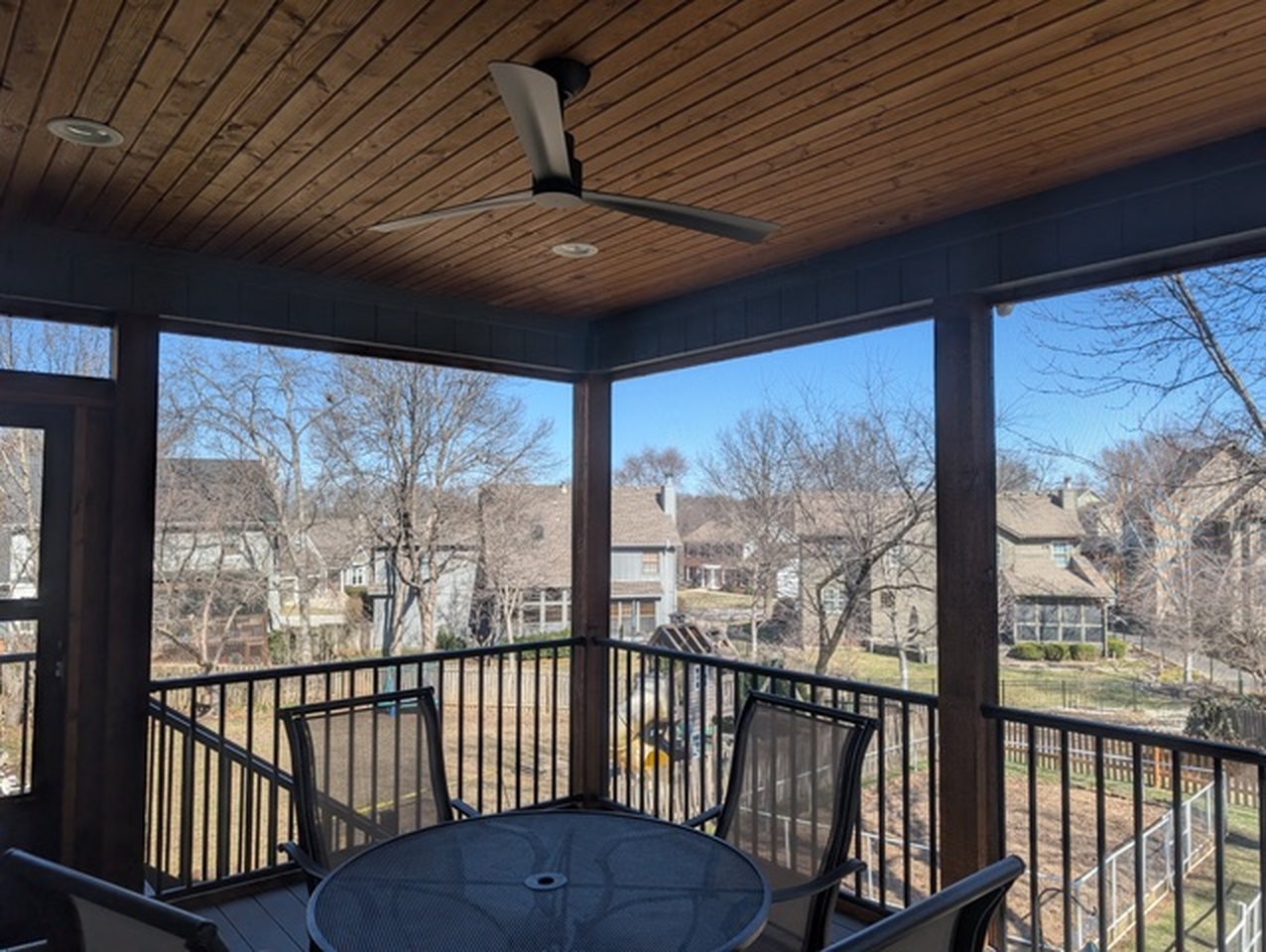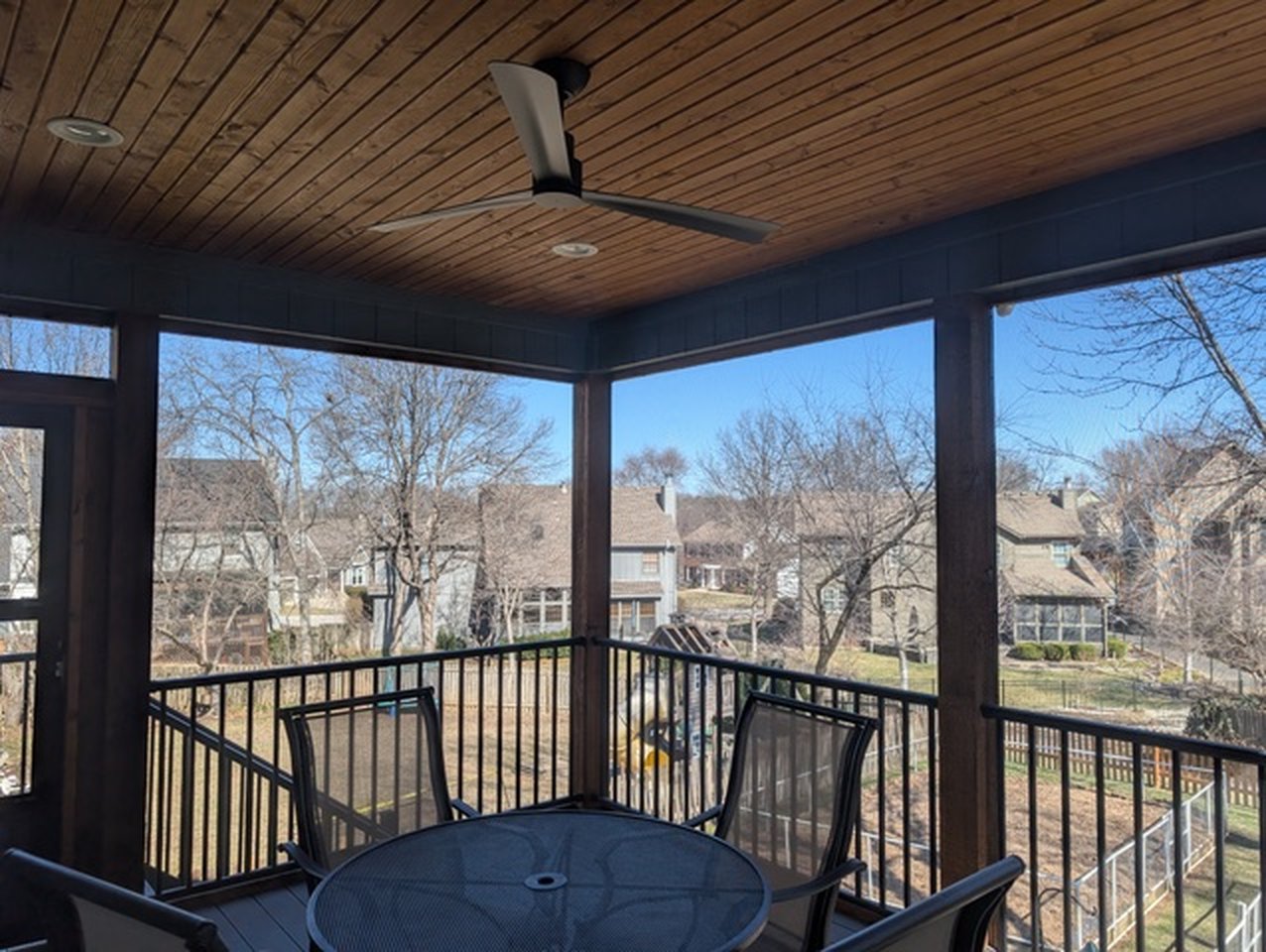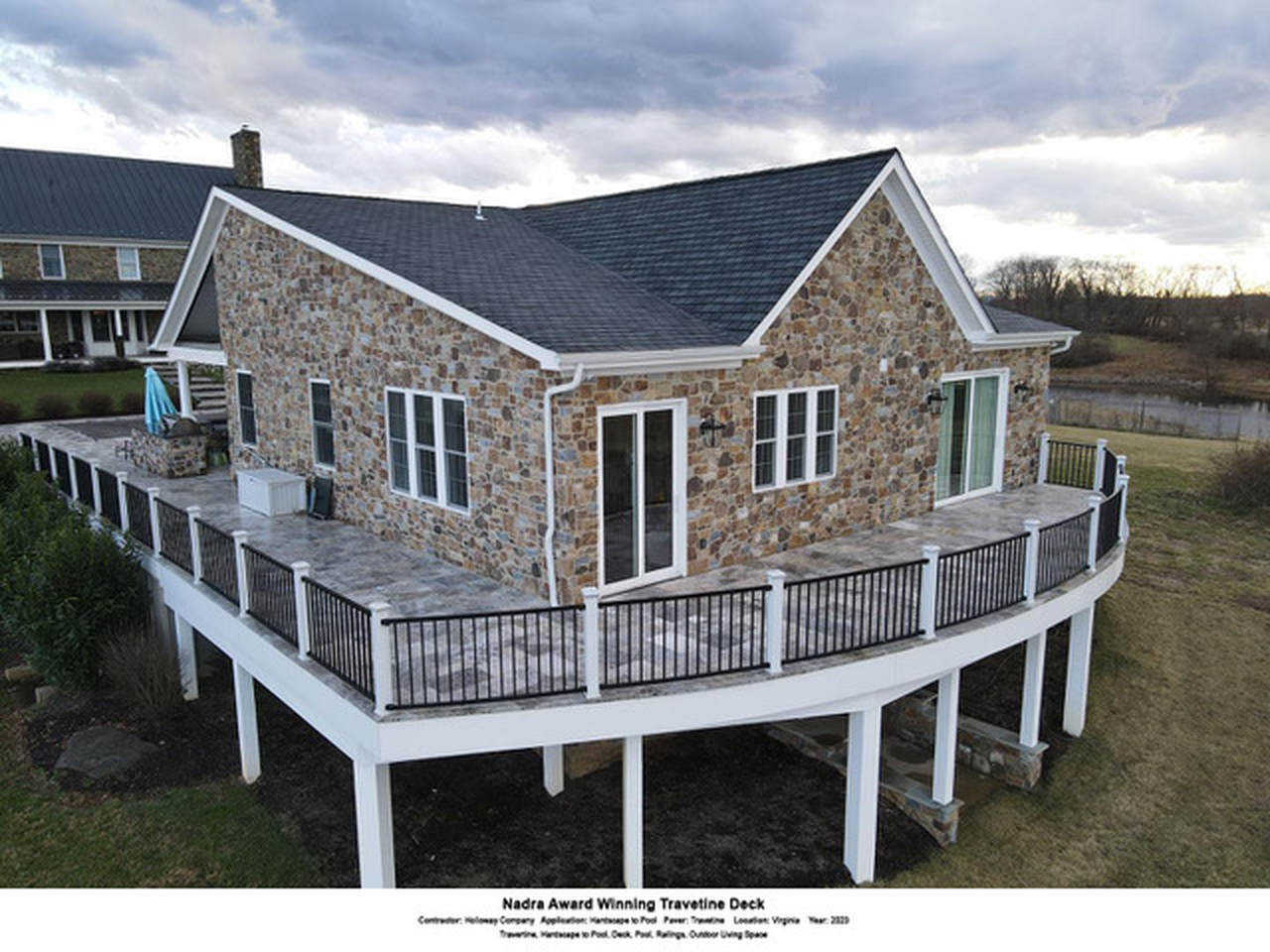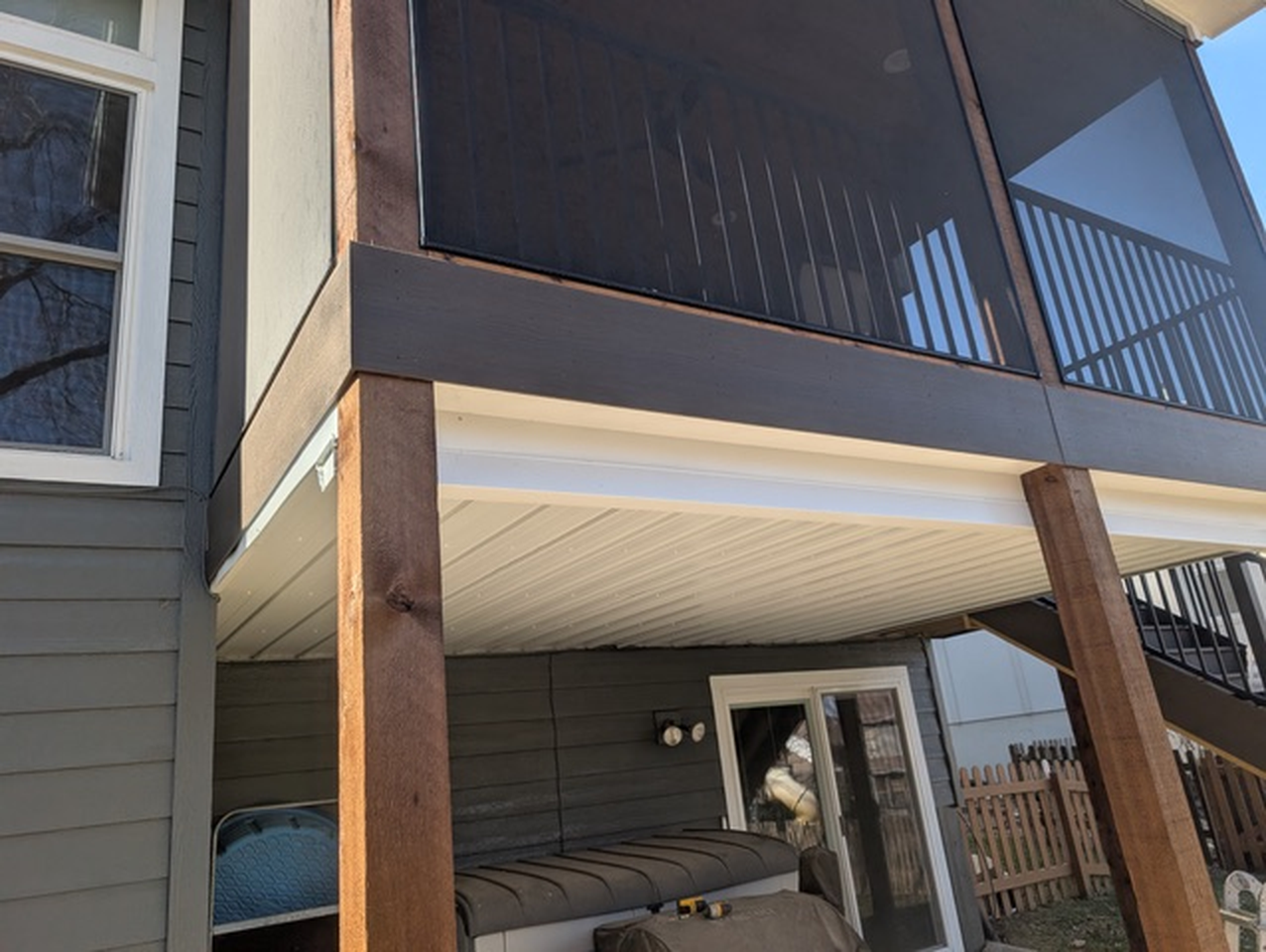
Cover photo: a real Acumen outdoor-living project. It illustrates a deck structure and is not a claim that the pictured materials or assembly carry a particular fire rating.
Class A decking has a low surface flame-spread classification under a specified test. It does not automatically mean noncombustible, fireproof, WUI-compliant, or rated for one hour. For a Kansas City project, the applicable code requirement and the complete deck system determine what documentation is needed.
A few months ago, I bid a complete deck replacement on a fourplex in Kansas City, Missouri. The existing structure was an older wood deck. The upper level was shared by the residents and connected to exterior stairs. Those stairs were one of two routes available to the upper units. There was a shared patio underneath, and the parking area extended right up to that outdoor space. My recollection from the review process is that Kansas City required the replacement project to reach a Class A fire rating.
At the time, I thought I understood what that meant. I knew steel and concrete were noncombustible, and I had always associated Class A with materials that essentially did not burn. So we worked backward from the requirement.
The owner had originally been considering a fairly conventional system: pressure-treated wood framing, wood railing components, and aluminum balusters. To meet the requirement as we understood it, I researched a Class A-rated deck board, proposed Fortress steel framing, and changed the railing concept to an all-aluminum Westbury system. That change more than doubled the cost of the project we were bidding.
We did not win the job, so our proposed system was never submitted to Kansas City for final approval. I also no longer have the original plan-review comment or code citation, so I am not going to tell you I know exactly what provision triggered the requirement. But the experience exposed a gap in my own understanding. I had always associated Class A with noncombustible. Those are not the same thing. Neither are Class A, fire-resistance-rated, ignition-resistant, fire-retardant-treated, and WUI-compliant.
Once I started digging into the testing, building codes, decking products, framing systems, and wildfire requirements, I realized the information was available—but scattered across a lot of different places. This article is my attempt to put those pieces together. It is not an argument that every Kansas City homeowner needs Class A decking or a metal deck frame. On most residential decks, my priorities are still maintenance, moisture management, structural longevity, movement, and how the homeowner actually intends to use the space.
But when fire performance matters, it helps to understand exactly what you are buying.
What Does a Class A Fire Rating Actually Mean?
When a manufacturer identifies a building material as Class A, B, or C based on surface-burning characteristics, the test behind that classification is commonly ASTM E84 or UL 723. ASTM E84 reports a flame-spread index and a smoke-developed index. The familiar Class A, B, and C surface-burning classifications use these ranges:
| Classification | Flame-Spread Index | Smoke-Developed Index |
|---|---|---|
| Class A | 0–25 | 0–450 |
| Class B | 26–75 | 0–450 |
| Class C | 76–200 | 0–450 |
A lower flame-spread index means the tested material allowed less flame travel across its surface during that test. That is useful information. But it is not the same thing as saying the material cannot burn. ASTM itself makes an important limitation clear: the test does not determine heat transmission through the material, and the flame-spread index by itself does not establish that a material is noncombustible.
ASTM E84 — Surface Burning Characteristics of Building Materials
That was the first major correction to my own understanding.
Class A Does Not Mean Fireproof
A Class A product can still be combustible. Wood can receive a Class A flame-spread classification. PVC can receive a Class A classification. That does not make either material the same thing as steel, aluminum, or concrete. The letter tells us how a particular product performed under a specific test. It does not tell us everything about how a completed deck will behave in a real fire.
Class A and Noncombustible Are Different Things
Noncombustibility is a separate question. A test such as ASTM E136 evaluates whether a material meets defined criteria for combustibility.
ASTM E136 — Combustibility of Materials
That gives us an important distinction: Class A describes very low flame spread under a particular test. Noncombustible describes a different material property evaluated under a different test framework. Steel and aluminum can be noncombustible. An Ipe board can achieve a Class A flame-spread classification and still be wood. Those statements are not contradictory. They are answering different questions.
Class A Is Not a One-Hour Fire Rating Either
Another term that gets mixed into this discussion is fire-resistance rating. If an architect or code official calls for a one-hour wall, floor, or assembly, that is not the same thing as asking for a Class A surface-burning material. Testing such as ASTM E119 evaluates building elements and assemblies under a prescribed fire exposure.
ASTM E119 — Fire Tests of Building Construction and Materials
So: Class A decking plus Class A framing does not automatically create a one-hour fire-rated deck assembly. The complete assembly and its construction details have to support whatever fire-resistance claim is being made.
Why Could a Fourplex Deck Be Treated Differently From a Backyard Deck?
This was one of the biggest questions I had after our Kansas City bid. Why would this old wood deck suddenly need a much more expensive material package? Several things made that project different from the typical single-family deck we build. Kansas City, Missouri’s published Building and Rehabilitation Code information identifies the 2018 IBC, with local amendments, as part of its code framework. Confirm the applicable edition and amendments for the project.
Kansas City, Missouri Building and Rehabilitation Code
Under the 2018 IBC, residential occupancies containing more than two dwelling units generally fall into Group R-2. A fourplex therefore crosses an important line that a detached single-family home or duplex generally does not.
2018 IBC — Occupancy Classification
That does not mean: Fourplex = Class A deck. It means the project enters a different code framework. Our project also had a shared upper deck connected to exterior stairs used by the residents. The IBC separately regulates exterior egress balconies and addresses issues such as width, capacity, wall separation, openness, location, and fire-separation distance.
Construction type can matter too. The IBC generally bases Type I and Type II construction on noncombustible building elements, subject to specific exceptions. Some of those exceptions deal with balconies, porches, decks, and exterior stairs, and the distinction between a deck that is simply outdoor living space and one that forms part of a required exit route can matter. I do not know which of these provisions caused the requirement on our particular project. That is exactly why I would approach the same plan-review comment differently today.
The First Question I Would Ask a Plan Reviewer Today
If I received a comment tomorrow saying: “This deck needs to be Class A.” I would not start by searching for the most expensive deck board. I would ask: What exactly is triggering the requirement, which components have to comply, and what test standard or code provision are we trying to satisfy? That matters because we could be dealing with very different issues:
surface flame spread, noncombustible construction, fire-retardant-treated wood, an exterior egress balcony, construction type, fire-separation distance, a WUI provision, or a fire-resistance-rated assembly. If I do not know which problem I am solving, I cannot tell the owner whether the proposed solution makes sense. That matters even more when the requirement can substantially increase the cost of the project.
Does Every Kansas City Deck Need Class A Decking?
No blanket requirement like that showed up in my research. The 2018 IRC’s plastic-composite deck-board provisions use a maximum flame-spread index of 200 under ASTM E84 or UL 723. That model-code provision is not a determination of what a particular Kansas City project requires. That reaches the top of the Class C range. It is not a blanket Class A requirement.
What applies to a particular deck can change with the jurisdiction, building type, occupancy, construction type, fire-separation distance, whether the deck serves as egress, and other project-specific conditions. That is why I would not take a requirement from a Denver project, a Kansas City fourplex, or a California WUI property and assume it applies to a detached home in Overland Park. The property and the actual code path come first.
What Does WUI Mean?
WUI stands for wildland–urban interface. These are areas where homes and developed property meet or intermingle with wildland vegetation. Kansas is part of that conversation too. The Kansas Forest Service discusses wildfire risk in Kansas WUI areas and provides resources for homeowners who want to evaluate their property and reduce fuel around structures.
Kansas Forest Service — Prepare Your Home for Wildfire
That does not mean Kansas City has automatically adopted the same WUI construction requirements as Colorado or California. Wildfire risk and WUI code applicability are two separate questions.
What Colorado Can Teach Us About WUI Decks
Colorado is useful because wildfire-resistant construction requirements have become much more visible there. Jefferson County’s published Wildfire Resiliency Code, Section 402.9, separates deck-surface requirements from framing requirements. Its applicability depends on the property and adopted rules. One surface compliance path permits approved composite lumber with an ASTM E84 flame-spread index no greater than 75; other permitted paths use different material or assembly criteria. An index of 75 is the upper end of Class B.
The framing provisions separately provide multiple compliance options.
Jefferson County Wildfire Resiliency Code
That is significant because even in a jurisdiction specifically addressing wildfire resilience, the answer is more complicated than: Every deck needs Class A decking over steel framing. It reinforces the same lesson: Understand the requirement before selecting the system.
Which Deck Boards Have Better Fire Ratings?
This is where product-specific research becomes important. There is no universal fire rating for “composite.” There is no universal fire rating for “PVC.” And there is no universal fire rating for every product made by the same manufacturer. Manufacturer-published examples reviewed for this article show how much classifications can vary. These are product-specific claims, not approvals for a completed deck.
| Product | Material | Published Fire Information |
|---|---|---|
| TimberTech Vintage | Advanced PVC | Class A |
| TimberTech Landmark | Advanced PVC | Class A |
| TimberTech Harvest+ | Advanced PVC | Class A |
| TimberTech Harvest | Advanced PVC | Class B |
| Fiberon Promenade | PVC | Class A |
| Fiberon Paramount | PVC | Class A |
| Fiberon Sanctuary FR | Composite | Class B |
| Fiberon Good Life FR | Composite | Class B |
| Deckorators Vista | Wood-plastic composite | ASTM E84 index 55 — Class B |
| Deckorators Venture | Wood-plastic composite | ASTM E84 index 85 — Class C |
| Deckorators Voyage / Summit | Mineral-based composite | ASTM E84 index 155 — Class C for documented configurations |
| Trex Refuge | PVC | Class A; manufacturer identifies WUI/IWUIC performance |
| Nova Ipe | Natural hardwood | Manufacturer identifies product as Class A |
| Nexan LockDry | Aluminum | Class A; manufacturer publishes flame-spread value of 0 |
These examples are not Acumen recommendations for every project. The rating needs to be verified for the exact board, profile, report, and installation being proposed.
TimberTech Shows Why the Exact Collection Matters
TimberTech is a useful example because products from the same manufacturer can carry different classifications. The manufacturer's current fire-performance information identifies Vintage, Landmark, and Harvest+ as Class A, while Harvest is listed as Class B.
TimberTech Fire-Resistant Decking
Same manufacturer. Different collection. Different classification.
Fiberon Shows Why the “FR” Designation Matters
Fiberon currently separates its Class A PVC products from specific fire-rated composite products. Promenade and Paramount are identified as Class A. Sanctuary FR and Good Life FR are identified as Class B.
Fiberon Fire-Resistant Decking
The FR designation matters. I would not assume ordinary Sanctuary decking carries the same fire documentation as Sanctuary FR simply because the names are similar.
Deckorators Shows Why Material Category Is Not Enough
Deckorators is another useful example. Its Vista technical information reports an ASTM E84 flame-spread index of 55, which places it in Class B. Venture is listed at 85, which is Class C. For Voyage and Summit, the published sheet reports 155, Class C, for the capped 5.5-, 7.25-, and 9.25-inch boards it covers. That sheet excludes 3.5-inch boards.
Deckorators Technical Information
That is a good reminder that mineral-based does not automatically mean noncombustible or Class A. The documentation wins over the assumption.
Trex Refuge Is Another Product-Specific Example
Trex currently identifies Refuge PVC decking as having a Class A flame-spread rating and publishes separate wildfire-related performance claims for the product.
Again, that statement belongs to the specific product. It should not automatically be assigned to every deck board made by Trex.
Where Does Ipe Fit?
Ipe is interesting because it demonstrates why Class A and noncombustible cannot be treated as synonyms. Ipe is wood. Nova currently identifies its Ipe decking product as Class A fire rated.
That does not make Ipe noncombustible. It means that particular documented product achieved that flame-spread classification. If I were specifying Ipe because a plan reviewer required Class A, I would want documentation for the actual product being purchased, rather than relying on a blanket statement that every Ipe board from every supplier has the same rating.
What About Aluminum Decking?
Aluminum can serve as the walking surface too, not just the framing underneath. Nexan's LockDry system is one example. Its published information identifies a Class A rating and a flame-spread value of 0.
Nexan LockDry Aluminum Decking
The profile is also designed to manage water through an interlocking aluminum system. That creates a very different assembly from installing PVC or composite boards over conventional wood framing. And that brings us to one of the most important lessons from this research: The walking surface and the deck framing are separate decisions.
A Fire-Rated Board Does Not Solve the Framing Underneath It
Most deck marketing focuses on what you can see. Fire can involve what you cannot see. ASTM has a separate test method, E2632, specifically intended to evaluate decking when exposed to a fire source below the deck surface.
ASTM E2632 — Under-Deck Fire Exposure
That alone should tell us something. Putting a board with a favorable surface flame-spread rating over combustible framing does not make the framing irrelevant. For a broader look at the structure below the deck, we already cover conventional lumber, steel, and other framing considerations in our existing guide:
Deck Framing Options in Kansas City
Fire performance is another layer on top of the usual decisions about moisture, spans, movement, durability, and long-term maintenance.
Pressure-Treated Lumber Is Not the Same as Fire-Retardant-Treated Lumber
This is another terminology trap. Most conventional deck framing is preservative-treated lumber. That treatment primarily addresses deterioration issues such as decay and insects. Fire-retardant-treated wood, or FRTW, is a different product category. Exterior-rated FRTW products do exist. Hoover’s ExteriorFireX is one example of an exterior, pressure-impregnated fire-retardant treatment marketed for applications including decks, balconies, and stairways.
But the manufacturer also makes an important point: it should not simply be treated as a substitute for preservative-treated lumber wherever decay resistance is required.
That is a good example of why the phrase fire-rated wood can oversimplify the decision. We still have to think about moisture exposure, species, structural performance, fasteners, connectors, and long-term durability.
What About Steel Deck Framing?
Steel is a much more direct way to remove combustible wood from the primary substructure. Fortress currently identifies its Evolution steel deck framing as noncombustible and publishes fire-related and WUI information for the system.
Fortress Evolution Steel Deck Framing
Those are meaningful characteristics. They still do not mean that every deck built with Fortress framing automatically becomes a one-hour fire-rated assembly. The framing is one component of the complete system.
Could We Spray Pressure-Treated Framing With a Fire Retardant?
This became one of the more interesting questions during my research. There are exterior fire-retardant liquids that can be sprayed, rolled, or brushed onto wood. Flamex PF-2 is one example. The manufacturer markets it for exterior wood and identifies applications involving decking and structural lumber.
Flamex PF-2 Exterior Wood Fire Retardant
That tells me the concept is real. It does not give me enough information to say: Spray this on any pressure-treated deck frame and now it is equivalent to a steel frame or factory-produced FRTW. Those are much larger claims.
Before I would rely on a field-applied treatment for code compliance, I would want answers to questions about the exact lumber, preservative treatment, moisture content, surface preparation, coverage, weathering, reapplication, joist tape, hangers, fasteners, and whether the code official accepts the treatment for the specific provision we are trying to satisfy. There is another practical issue too.
If the product requires future reapplication, how do we retreat the top of a joist after deck boards, joist tape, blocking, and hardware have made parts of that framing inaccessible? That is why I think this category is worth watching, but I am not ready to tell a homeowner that a field-applied treatment is automatically an equivalent substitute for steel or factory-treated FRTW.
Stone, Porcelain, and Paver Deck Systems
Another way to change the fire characteristics of the walking surface is to move away from conventional deck boards altogether. Stone, concrete, porcelain, and exterior tile can make sense in certain applications. But the visible finish still does not tell us what the supporting system is made of.
StoneDeks-Type Systems
StoneDeks uses a support-grate system that allows pavers or other masonry finishes to be installed over deck framing. The important fire-related point is simple: A stone or concrete paver on top does not automatically make the structure underneath noncombustible. The support grate and the framing still need to be evaluated.
Steel Paver Platforms
PAVERDECK takes a different approach by using cold-formed steel structural panels as the platform for stone or paver finishes.
That is a fundamentally different support system from pavers installed over conventional wood joists.
Porcelain Pavers
Porcelain systems introduce another issue: weight. A paver assembly can add considerably more dead load than conventional deck boards. Bison’s 2CM porcelain-paver documentation gives weights for the pavers and supporting components, illustrating why the complete dead load needs to be reviewed.
That may be completely manageable in a structure designed for it. It is not something I would simply place over an existing deck without checking the joists, beams, posts, footings, connections, and the required support system.
What About the Old Deckorators Deck Stones Idea?
Some contractors may remember Deckorators Deck Stones, an older product concept that allowed stone-type panels to be incorporated into deck construction. I remember systems like that because they addressed a practical problem. Sometimes a homeowner does not need an entirely different deck. They may simply want a different surface in one particular area. I have done something similar in the field.
Roughly ten years ago, we built two decks where we added solid blocking, cement board, and exterior tile in the portion of the deck intended for a grill. One was in Louisiana, where freeze-thaw exposure was obviously very different from Kansas City. I do not have enough long-term information on the Midwest installation to tell you I would build that exact detail the same way today.
On another project, a homeowner already had a gas line stubbed out. We added blocking and built a custom side-mounted support so the grill did not consume the primary deck surface. The plumber handled the gas connection. Those were project-specific solutions. I would not turn them into a universal grill detail.
Grills Are One Reason Fire Performance Might Move Up the Priority List
Normally when somebody asks me whether a deck is going to be “hot,” they mean: How hot will the board get on my bare feet? They are not asking about ASTM E84. For the typical Kansas City homeowner, fire rating usually falls well below maintenance, moisture resistance, structural longevity, appearance, movement, and everyday usability on my priority list. But the reason matters.
If somebody specifically wants a less-combustible surface in an outdoor cooking area, then aluminum, stone, concrete, or a properly designed porcelain system may be worth evaluating. Appliance placement and installation also need their own review. The grill manufacturer's clearances, surrounding materials, utilities, overhead construction, and applicable code requirements still have to be followed. A Class A board is not permission to put a grill anywhere you want.
Why Was the Siding Allowed to Be Combustible?
This was another question I had on the Kansas City fourplex. The deck was recessed between exterior walls clad with LP SmartSide. My practical reaction was: If we are this concerned about the deck burning, what happens when the siding next to it is combustible? At the time, I did not get an explanation from the plan reviewer that made the distinction clear to me. After doing this research, I look at that question differently.
Building codes do not necessarily regulate every component of a building according to one universal combustibility requirement. The deck, exterior wall, cladding, egress path, structure, railing, roof, and other elements can each fall under different provisions because they perform different functions. That does not mean a fire cares which chapter of the code the material came from. It means the code may be trying to accomplish a specific life-safety objective in a specific part of the building.
If a shared balcony forms part of the route people use to get out, limiting flame spread or combustible construction in that area may matter even though combustible materials exist elsewhere. I still want to know which requirement we are satisfying before spending the owner's money. But I understand the reasoning better than I did when I first saw that plan-review comment.
Questions to Ask Before Paying for a Fire-Related Deck Upgrade
Before changing an entire deck specification because somebody says “Class A” or “fire rated,” I would want answers to these questions:
| Question | Why It Matters |
|---|---|
| What code section is driving the requirement? | It tells us what problem is actually being addressed. |
| Which components must comply? | Decking, framing, railing, and complete assemblies are not automatically treated the same. |
| What test standard applies? | ASTM E84, E119, E136, E2632, and WUI testing answer different questions. |
| Is the deck part of a required exit or shared egress path? | An exterior egress balcony can be treated differently from a private backyard deck. |
| What is the building occupancy? | A fourplex can fall under a different code framework than a one- or two-family property. |
| What is the construction type? | This can affect where combustible construction is permitted. |
| What is the fire-separation distance? | Nearby construction and property lines can affect projection requirements. |
| Is the exact product documented for the required classification? | Brand and material category are not enough. |
| Are there installation conditions tied to the approval? | Gaps, framing, fastening, spacing, and other details may matter. |
| What maintenance is required? | Especially important with field-applied treatments. |
| Is this required or simply an optional upgrade? | That can completely change whether the added cost makes sense. |
That is the checklist I wish I had when I first saw the Class A requirement on the fourplex.
What I Learned From This Research
Fire rating is not going to become the first thing I talk about on every deck. For most of our Kansas City projects, I am still going to spend more time thinking about whether the framing stays straight, how we keep water out of connections, how the deck drains, what maintenance the homeowner is willing to do, and whether the material makes sense for the way the space will actually be used. But now I know there are several different questions hiding behind the words fire rated. A Class A board is not automatically noncombustible.
A noncombustible steel or aluminum frame does not automatically create a one-hour assembly. A WUI-compliant board does not automatically make the complete deck or property WUI compliant. A stone walking surface does not tell you what is underneath it. Pressure-treated lumber and fire-retardant-treated lumber are not the same thing. And spraying a fire-retardant product onto a wood frame does not automatically make it equivalent to factory-treated FRTW or noncombustible framing. The biggest lesson for me is simpler:
Understand why the requirement exists before deciding how to satisfy it. Sometimes that may lead to steel framing and a Class A deck board. Sometimes Class B may satisfy the actual requirement. Sometimes a paver or aluminum surface may solve a specific use problem. Sometimes there may be no code or practical reason for a homeowner to pay more for fire performance at all. The goal is not to collect the most fire-related labels. It is to understand what each one means and make an informed decision about the complete system.
For a deeper look at the structure underneath the deck, read our Deck Framing Options in Kansas City. You can also review our deck construction services to see how we approach decking, framing, permitting, and complete outdoor-living projects throughout the Kansas City metro. Schedule a Consultation if you have a deck project where the materials, structure, or local requirements need to be worked through before you choose a system.
Frequently Asked Questions About Fire-Rated Decking
Is Class A decking noncombustible?
Not necessarily. Class A describes surface-burning performance under a specified test. Noncombustibility is evaluated separately; a Class A wood or PVC product can still be combustible.
Does every Kansas City deck need Class A boards?
Do not assume a universal Class A requirement. The jurisdiction, occupancy, construction type, egress role, and other project conditions determine what applies. Ask the plan reviewer for the relevant code provision.
Does steel framing make a deck a one-hour assembly?
No. A noncombustible frame does not by itself establish a one-hour fire-resistance rating for the completed deck. Any assembly rating must be supported by the applicable tested or approved construction details.
Is a WUI-compliant board enough for the whole deck?
No. The product documentation and local requirements can also address the framing, installation, surroundings, and other parts of the property. Verify the complete system for the actual project.