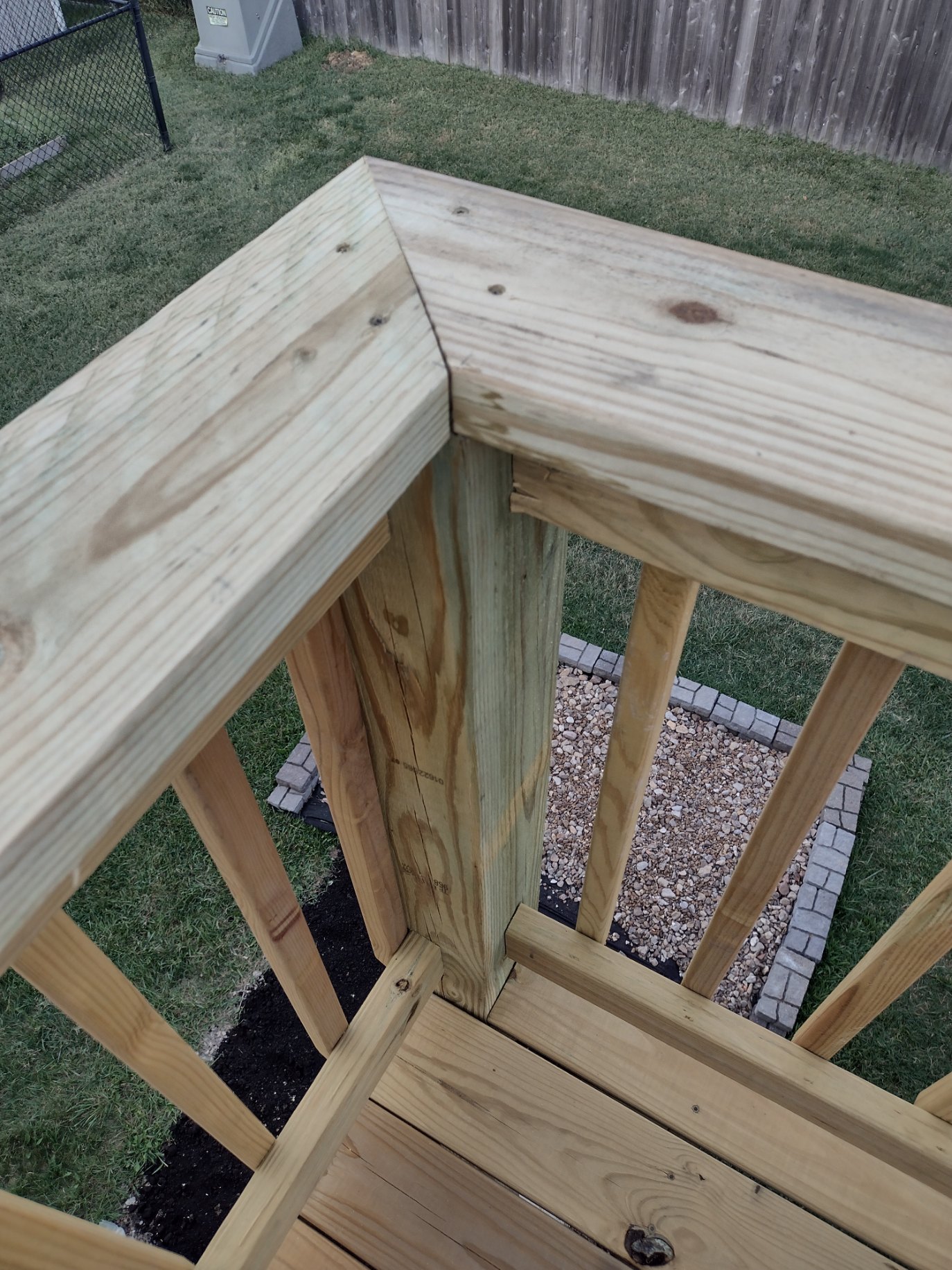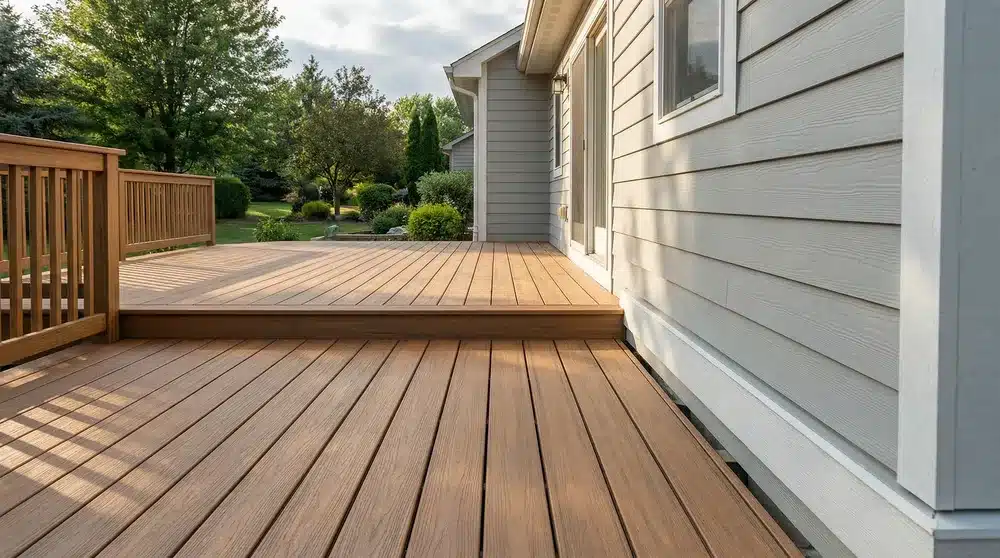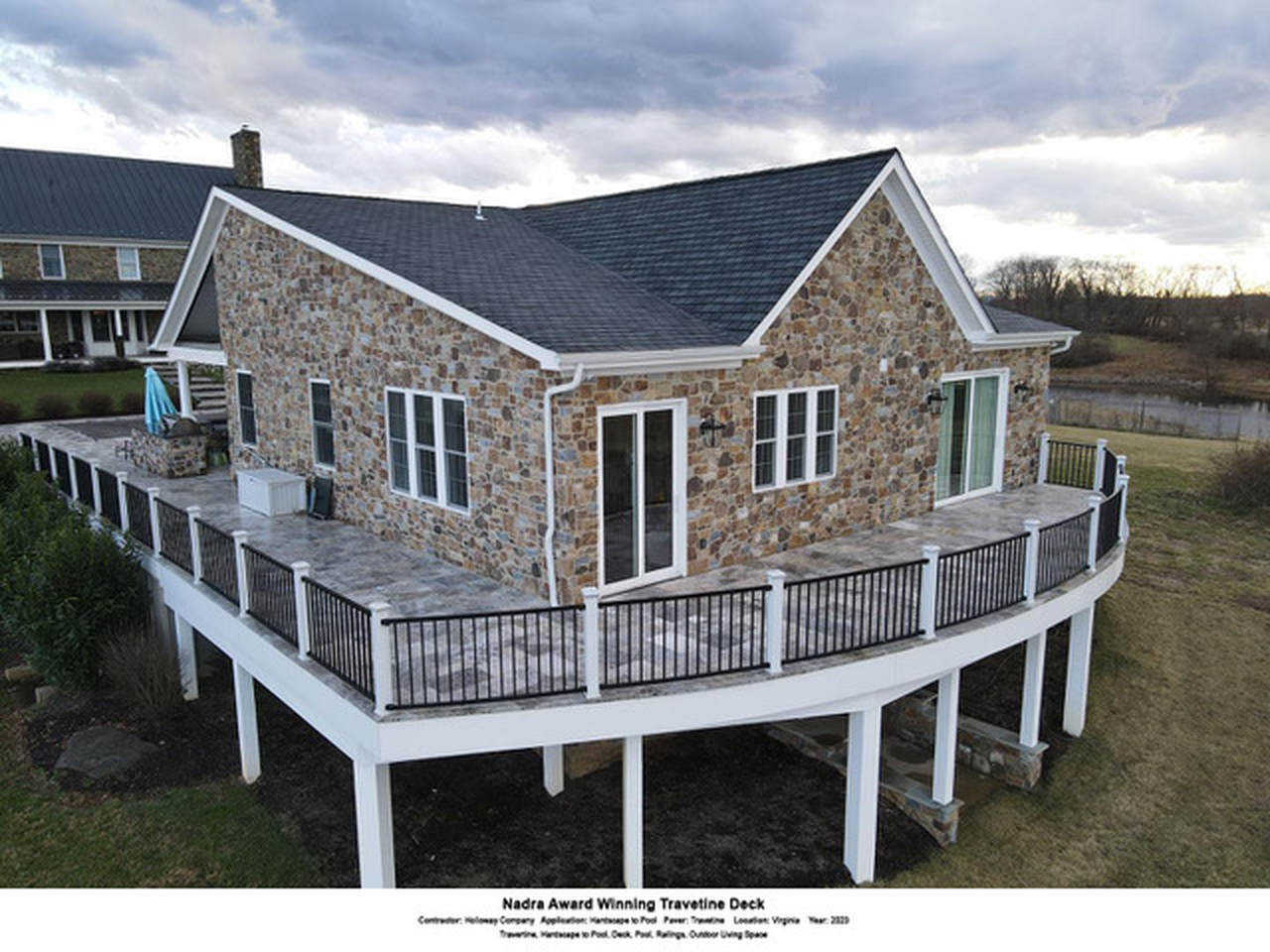
Project images supplied by StoneDeks; original credits retained. Acumen has not installed these pictured projects.
Quick Answer
Yes. An elevated deck does not have to be finished with wood, composite, or PVC deck boards.
StoneDeks uses a structural grate system called SilcaGrate that installs over properly designed deck framing and supports compatible hardscape materials such as travertine, porcelain pavers, natural stone, concrete pavers, and brick. StoneDeks currently lists compatible surface materials ranging from 3/4 inch to 3 inches thick, although the specific material and assembly still need to be evaluated together. Stone Decks
That opens up a different way to think about a deck.
Instead of asking which board looks the most like wood, you can consider an elevated outdoor space with the character of a patio, pool terrace, or outdoor kitchen.
I want to be clear at the beginning: Acumen Renovations has not installed a StoneDeks project yet.
I have met the owner of StoneDeks, had multiple conversations with the company, studied its technical information, and spoken directly with contractors StoneDeks referred me to who have installed the system.
I wanted to understand both sides: what makes contractors choose this approach, where installation becomes more involved, and what we would need to plan differently before building one for a client.
The appeal is not just that you can put stone on a deck. It is the wider range of colors, textures, surface sizes, and layouts that becomes available when you move beyond deck boards. For a contractor, that creates another way to approach an outdoor space. For a homeowner, it creates more opportunities to coordinate the deck with a patio, pool, or cooking area.
Once we complete our first installation, we will update this article with what we learn in the field.
For now, this is what has my attention.
Why I Started Looking for an Alternative to Deck Boards
For me, the search started with heat.
On a deck that receives direct summer sun, surface temperature matters. Around a pool, where people are often barefoot, it matters even more.
That led me to StoneDeks.
StoneDeks describes the potential for stone surfaces to remain cooler than composite decking in direct sunlight. Its current guidance also explains that surface temperature depends on the material, color, and sun exposure. That is an important qualification: the support system does not make every possible finish cool underfoot. Stone Decks
I have not independently tested surface temperatures, so I am not presenting this as an Acumen test result or promising a particular temperature difference.
The possibility interested me enough to keep researching. Then I realized heat was only part of the story.
StoneDeks Changes the Question From “Which Deck Board?” to “Which Surface?”
Most deck conversations start with wood, composite, or PVC.
Those are legitimate choices, and they remain part of our custom deck options. But they are still deck-board choices.
StoneDeks creates a support surface over the framing so the finished walking surface can instead be compatible hardscape. The manufacturer’s material options include natural stone, porcelain pavers, travertine, concrete pavers, and brick. Stone Decks
That is what I find compelling.
A homeowner who likes the linear layout and woodgrain appearance of conventional decking may have little reason to change direction.
A homeowner who wants the space to feel more like an elevated patio or pool terrace is asking a different design question. StoneDeks gives us another option to investigate.
Travertine: Probably the Material That Gets the Most Attention
Travertine was one of the first finishes that caught my attention.
But it was also the subject of one of the strongest cautions from my installer conversations: do not assume every travertine product is appropriate for a Kansas City exterior installation.
One experienced installer was particularly concerned about certain veined material in freeze-thaw environments. I would not turn that conversation into a blanket statement that all veined travertine will fail.
The broader issue is the suitability of the specific stone.
The Natural Stone Institute notes that relatively few limestone varieties have an established history of successful exterior paving use in freeze-thaw environments. Travertine is part of the limestone family, and absorption varies considerably among stones in this group. Natural Stone Institute
In its technical review of this article, StoneDeks also emphasized that much travertine is porous. Water can enter those pores and contribute to chipping during freeze-thaw cycles.
That makes product selection important.
For a Kansas City project, I would want documentation showing that the specific travertine is appropriate for exterior horizontal use and freeze-thaw exposure. I would also ask the supplier whether a sealer is recommended for that product and application.
A sealer recommendation would not replace the need to choose suitable stone in the first place.
The product name “travertine” and a color sample are not enough information to make that decision.
Porcelain Pavers May Be One of the Most Practical Options
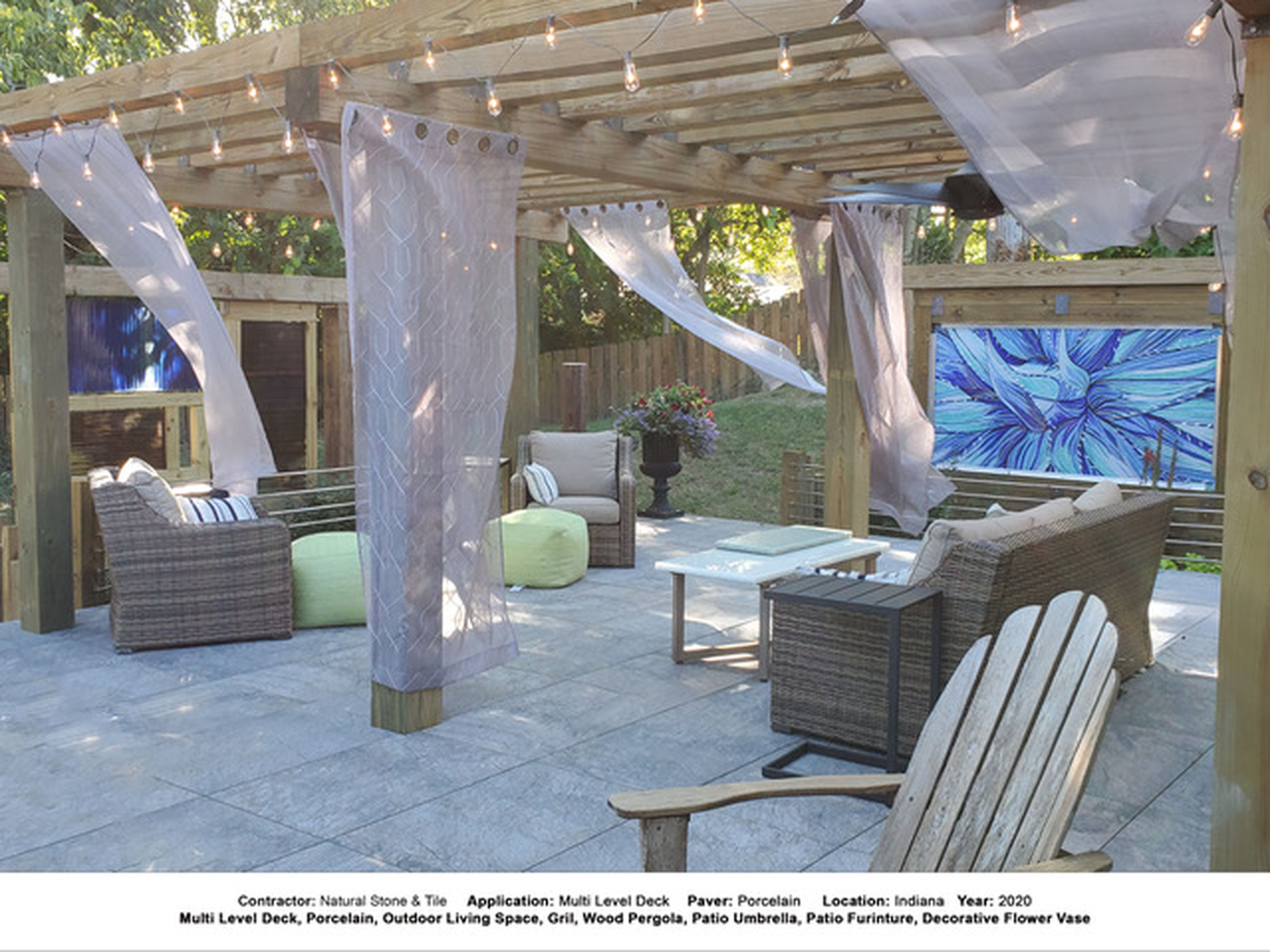
Porcelain interests me for a different reason. I like the possibility of a more controlled appearance, with coordinated sizes, colors, and patterns.
Here, the terminology matters: I am talking about exterior porcelain pavers, not ordinary porcelain tile.
During its technical review, StoneDeks recommended making that distinction because tile may not provide the slip resistance needed for this outdoor application. Its installer resource library also includes a dedicated porcelain-paver installation method. Stone Decks
That does not mean the word “paver” automatically makes a product appropriate.
For a Kansas City project, I would still verify that the exact product is intended for exterior use, that its thickness and installation requirements work with the StoneDeks assembly, and that its freeze-thaw and slip-resistance information match the application.
Around a pool, I would pay particular attention to the manufacturer’s guidance for wet, barefoot use.
This is not a situation where I would select a product simply because the box says “porcelain.”
The surface and the support system need to be selected together.
Natural Stone Opens Up a Different Design Category
StoneDeks also supports other compatible natural stone products, including options such as bluestone. Stone Decks
That creates the possibility of an elevated space with the character of a stone terrace rather than a conventional raised deck.
I find that especially interesting when the deck connects to landscaping, a patio, a pool area, retaining walls, or another masonry feature.
Instead of changing abruptly from stone at ground level to a simulated woodgrain surface above it, the materials can be coordinated across the outdoor space.
That brings me to one of the details I like most about this system.
You Can Carry the Hardscape Down the Stairs
StoneDeks publishes a dedicated stair application. Its installation training shows SilcaGrate being cut and installed at stair treads, followed by the selected stone or paver finish. Its technical library also includes stair application drawings. Stone Decks
From a design standpoint, I think that matters.
When planning an elevated stone or travertine deck, I would want to explore whether the same material could continue down the stairs rather than automatically switching back to composite boards.
Some installers are also carrying tile or travertine onto fascia areas to create a more continuous hardscape appearance.
I would treat that as a separate detail to resolve, not assume a walking-surface installation method automatically applies to a vertical surface.
The goal would be a coordinated design, with the support and attachment details worked out before construction.
The Biggest Challenge Is Not the Grate. It Is the Structure Underneath It.
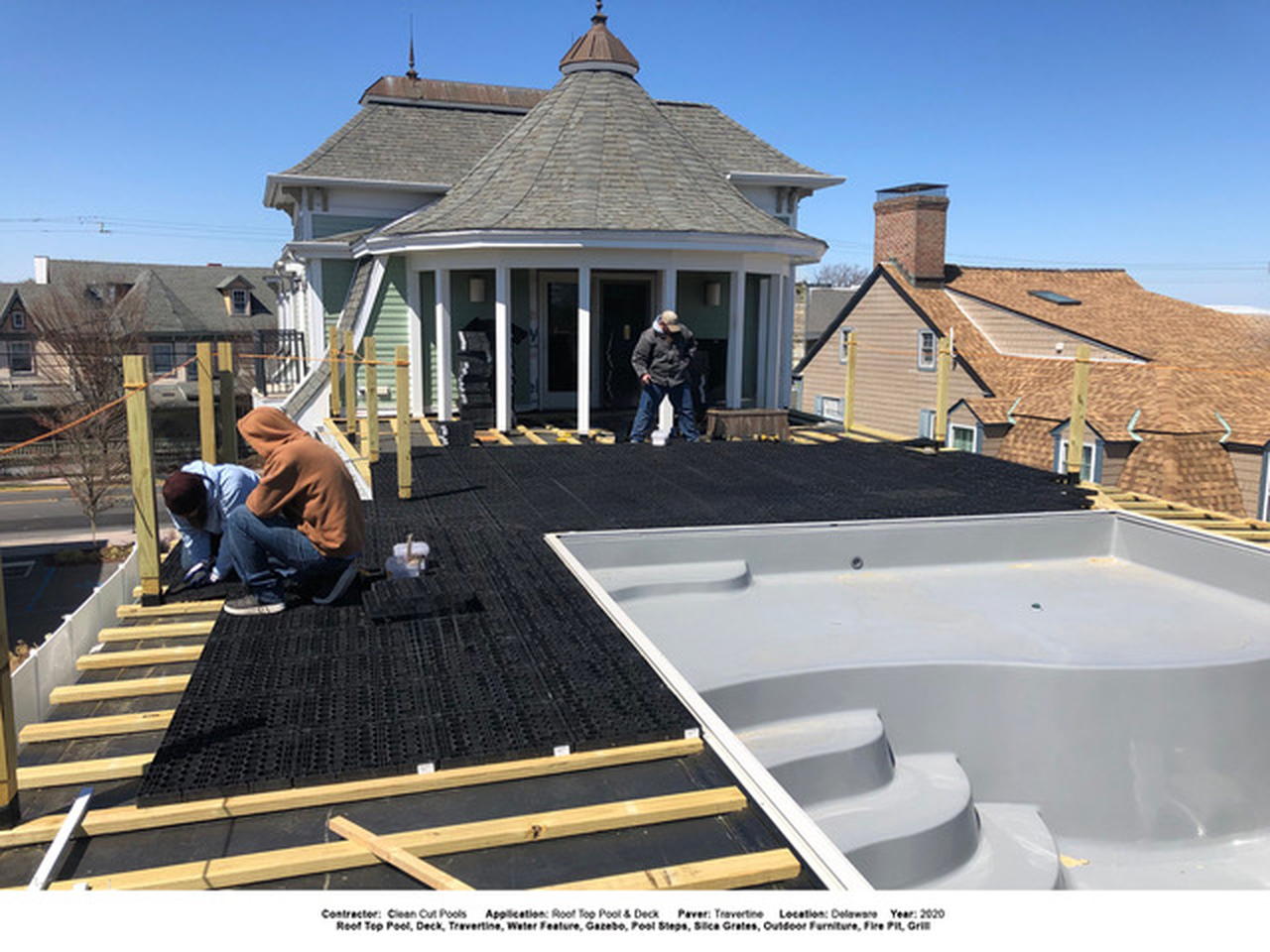
This may be the most important part of the article.
The supporting structure has to be designed for the weight of the complete assembly. StoneDeks’ new-construction guidance also calls for the finished floor elevation and material thickness to be considered before framing begins, and it describes construction using 16-inch-on-center floor joists. Stone Decks
There is useful support available for that planning.
StoneDeks provides engineer-sealed framing design tables addressing components such as joist spans, beam and post spacing, footing sizes, and connection requirements for the configurations covered by those tables. Stone Decks
Those resources are important. A contractor does not have to approach the system without technical guidance.
They still need to be applied to the actual project. I would not treat a manufacturer’s design table as blanket approval for every deck, every site condition, or every local permitting requirement.
When evaluating a StoneDeks design, I would work through the additional dead load—the permanent weight of the grate and finish—along with footing and pier sizing, beam and joist capacity, deflection, and the connection to the house.
I would also resolve finished elevations at doors, stair geometry, railing attachment, fastener embedment, drainage, and the surface layout.
These decisions are connected. The selected paver thickness affects more than how the finished deck looks.
Our guide to deck framing options in Kansas City discusses why the structure deserves attention before the finish is chosen. With an elevated hardscape surface, I would make those decisions together.
Why I Would Prefer StoneDeks on a New Deck
StoneDeks publishes resurfacing guidance for existing decks and calls for evaluating the existing framing before proceeding. An existing deck is therefore a possibility, not an automatic rejection. Stone Decks
Personally, I would prefer to start with new construction.
That is not a statement that an existing deck can never work. It is a preference about how I would approach the design.
When the finished surface is known from the beginning, we can plan the footings, beams, joists, connections, and finished elevations around that assembly.
Converting an existing deck requires answering a different question: can this particular structure support the proposed system, and what changes would be necessary?
I would want that answer before ordering the stone.
StoneDeks Requires More Decisions Before Construction Starts
One of the installers I spoke with described StoneDeks as more time-consuming.
That makes sense to me, particularly when considering the layout.
A conventional deck-board installation already requires planning. With hardscape, I would also want to know where joints land, what size material we are using, whether there is a border, and how the pattern meets the house.
Then come the transitions: stairs, fascia, railing posts, columns, pergola posts, and any outdoor kitchen features.
Those decisions affect the cuts and the finished appearance. I would rather resolve them while reviewing a layout than after material has been cut.
The contractors I spoke with also emphasized having the proper equipment to cut stone and porcelain.
That does not make StoneDeks an unreasonable choice. It means the installation needs to be approached as a hardscape project on a designed structure, not simply as another deck-board installation.
Railing Posts Need a Planned Detail—Not Automatically Drilled Pavers
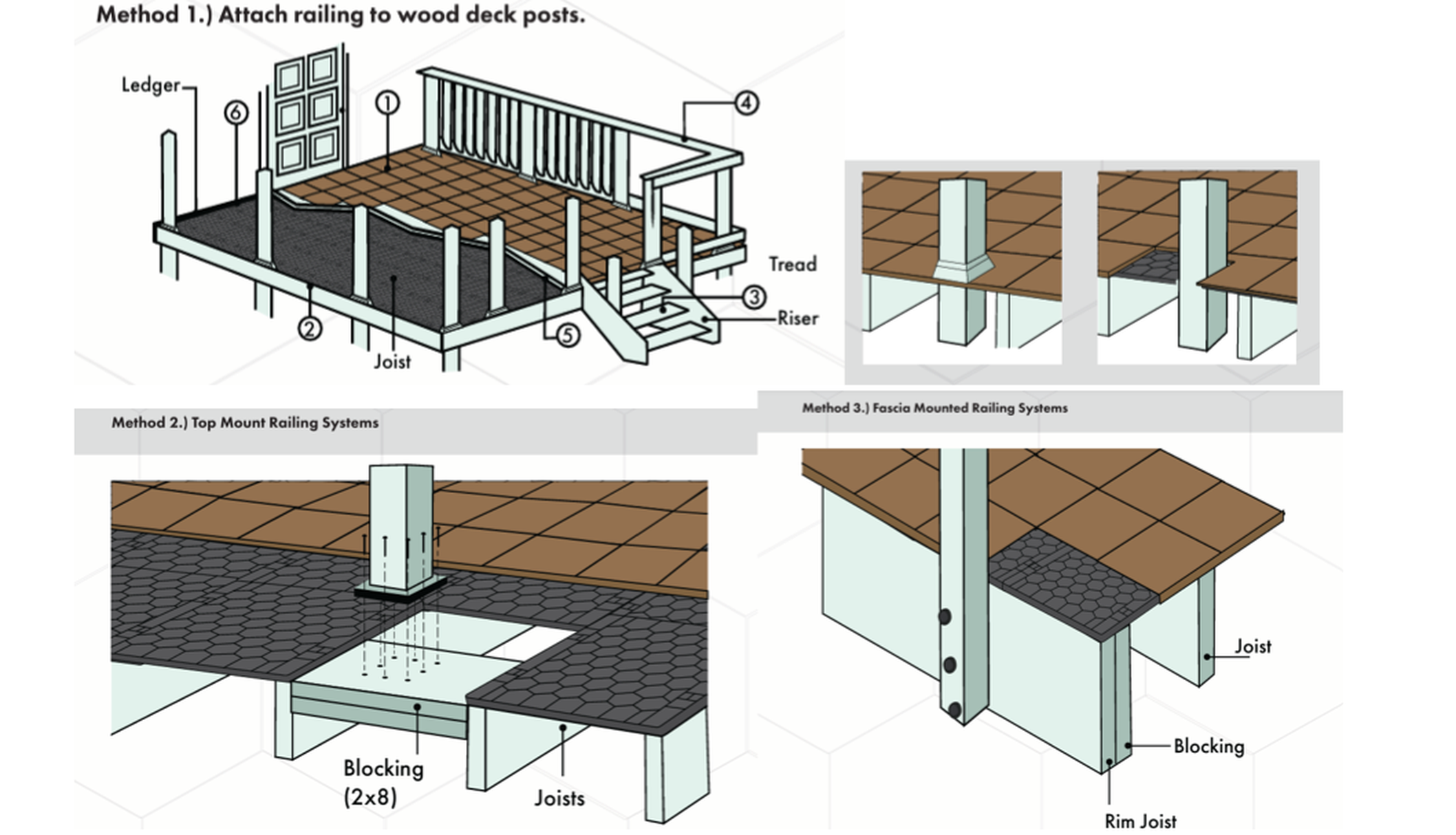
A StoneDeks surface does not prevent the use of conventional deck railing.
It also does not mean every railing post needs to be installed by drilling through a finished paver.
In its technical review, StoneDeks explained that many of its contractors install the railing first, cut the pavers to fit around the posts, and finish the opening with decorative trim.
The manufacturer’s published railing guide illustrates that approach. It also requires framing or blocking beneath cut SilcaGrate edges. Stone Decks
That changes how I would plan the sequence of work.
I would establish the post locations, structural attachment, blocking, fasteners, and trim details before finalizing the paver layout.
Where a particular design does call for an attachment through the finished assembly, the total thickness and required structural embedment still need to be addressed.
The important point is not that drilling is always necessary—or always prohibited. It is that the railing connection needs a planned detail.
I discuss the importance of post connections and blocking more broadly in our article, “What We Find When We Tear a Deck Railing Apart.”
Pool Decks Are Where This Really Starts to Make Sense to Me
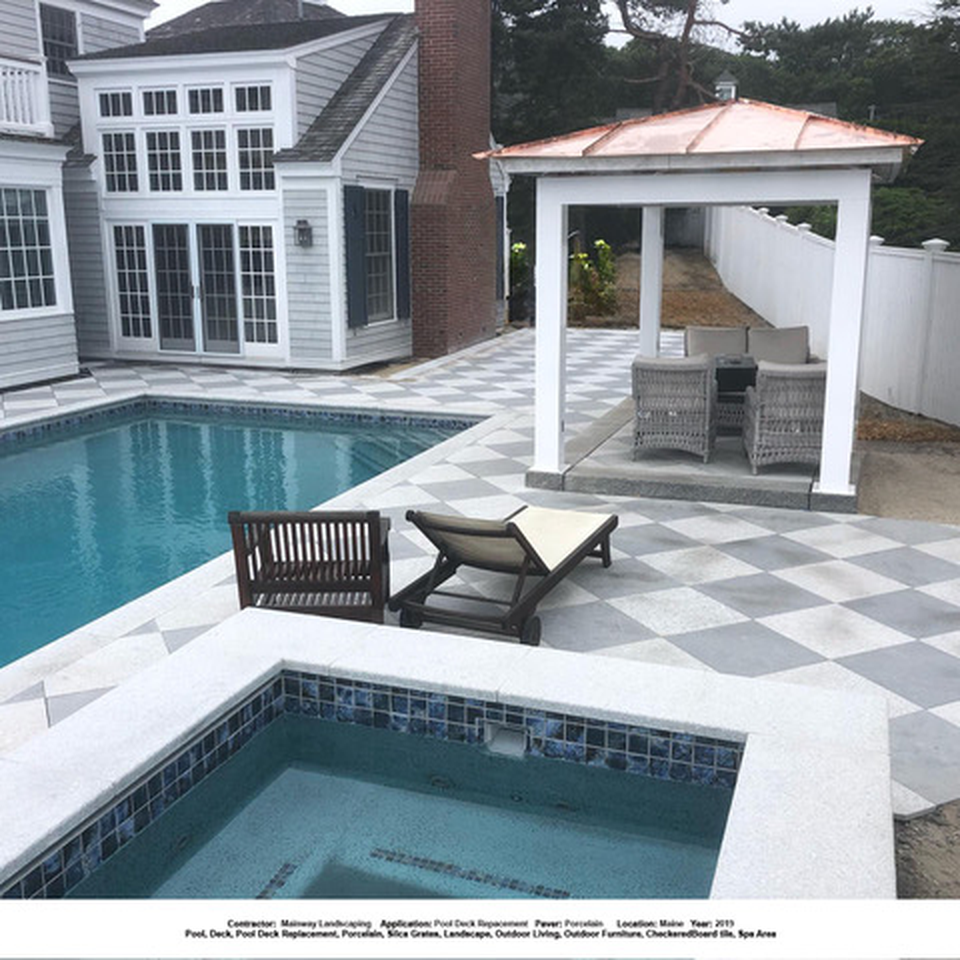
An elevated deck adjacent to a pool is one application where I think homeowners should at least know StoneDeks exists.
Surface temperature first drew my attention, but I would also be considering barefoot comfort, wet-surface traction, drainage, cleaning, and how the elevated deck connects visually to the pool hardscape.
The selected finish is critical.
StoneDeks notes that slip resistance varies by material and directs users to the paver manufacturer’s specifications. The grate does not make an unsuitable walking surface slip-resistant. Stone Decks
For me, that means a pool-deck surface needs to be chosen for its intended use, not just its appearance.
I would also avoid promising that any stone or porcelain paver will remain comfortable under every combination of weather and sun exposure.
The value of this system is that it opens up more material choices. Those choices still need to be evaluated.
Outdoor Kitchens and Grills Are Another Interesting Application
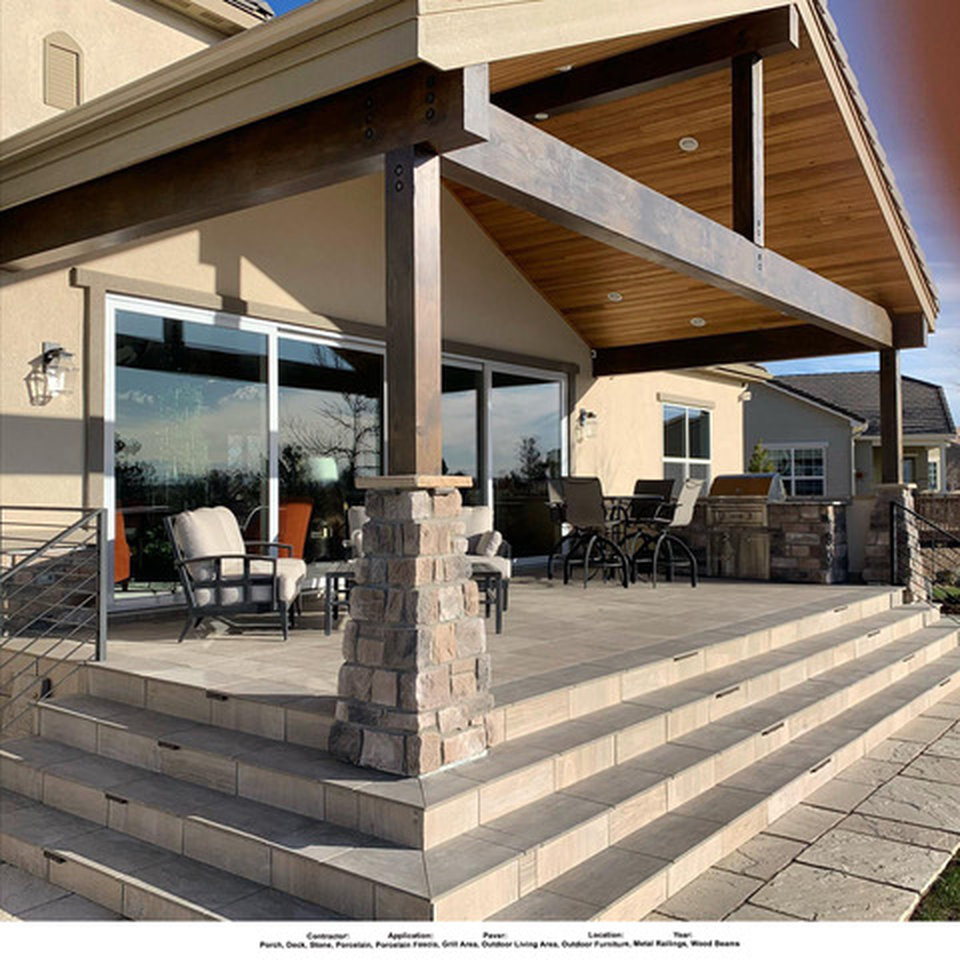
Outdoor cooking was not the first reason I became interested in StoneDeks, but it became part of the appeal.
I like the possibility of a properly selected hardscape surface around an outdoor kitchen, with the finish coordinated with the rest of the space.
StoneDeks also raised an option that does not require choosing stone for the entire deck: a hardscape insert within a composite deck around an outdoor kitchen or fire feature. Its published comparison materials discuss combining composite and stone for these applications. Stone Decks
That is an interesting compromise.
A homeowner could retain the deck-board appearance across most of the space while incorporating a different surface in a specific area.
I would still want the insert’s support, finished height, transitions, equipment loads, and appliance requirements addressed as part of the design. It is not simply a matter of setting a few pavers on top of composite decking.
Most importantly, a hardscape surface does not make the entire deck fireproof.
The framing, railing, siding, overhead structures, nearby combustible materials, appliance placement, and grease management still matter. The U.S. Fire Administration specifically cautions about grill placement near siding, deck railings, and overhead combustible materials. U.S. Fire Administration
I would never present a stone insert as blanket approval to place a grill or fire feature wherever a homeowner chooses.
What I like is the opportunity to design the cooking area and its surface together.
Cleaning Is Different Too
A hardscape deck may feel more like an outdoor floor than a deck-board surface. Depending on the finish, cleaning could include mopping and treating spills in ways that feel familiar from other hard surfaces.
But the material still determines the maintenance.
The Natural Stone Institute recommends appropriate stone cleaners and warns that acidic products can etch calcium-based stones such as travertine and limestone. It also explains that some stones benefit from a penetrating treatment while others may not require one. Natural Stone Institute
I would not describe StoneDeks as “maintenance-free.”
Porcelain, travertine, granite, and concrete pavers should not be treated as interchangeable maintenance categories.
I would choose the surface with an understanding of its care requirements, then follow the recommendations for that specific product.
What Happens If One Piece Gets Damaged?
An individual paver or stone also presents a potential repair advantage.
Depending on the layout and installation, replacing one accessible piece may be more manageable than replacing a long deck board that extends beneath posts or other features.
I would not promise that every repair will be easy. Access, the installation method, and anything built over the surface can change that.
I would give the same advice I give with many exterior finish materials: keep some leftover material from the original project.
Natural stone has variation. Manufactured finishes can vary between production runs, and products or colors may become unavailable.
Keeping spare pieces is a practical step I would include in planning for future repairs.
What Does a StoneDeks Deck Cost?
I am not going to publish an installed price per square foot and imply that it comes from Acumen’s StoneDeks installation experience.
The project needs to be evaluated as a complete assembly.
The first cost category is the StoneDeks support system, including the components required for the chosen installation.
The second is the finished hardscape material. Travertine, porcelain pavers, concrete pavers, and other natural stones are different selections, with different purchasing and installation considerations.
The structure is another major part of the scope. The proposed surface needs to be considered alongside framing, beams, footings, connections, and any required changes to an existing deck.
Then there is labor: handling material, making cuts, establishing the layout, and completing borders, stairs, fascia, and transitions.
Finally, there is design complexity. I would not evaluate a simple rectangular paver field the same way I would a multi-level deck with stone stairs, an outdoor kitchen, and multiple changes in surface material.
For a homeowner, the useful comparison is between complete proposed projects—not the price of a deck board and the price of a paver considered in isolation.
When Would I Still Choose Composite?
There are plenty of situations where I would still recommend conventional decking.
Styling preference is one. Some homeowners want the linear board layout and woodgrain appearance of a deck, not the appearance of an elevated patio.
The construction approach is another consideration. A conventional composite installation can involve fewer individual hardscape cuts and finish transitions, depending on the design. StoneDeks’ own comparison acknowledges that stone installations can be more labor-intensive. Stone Decks
I would consider StoneDeks when the homeowner values the additional surface choices enough to make the planning worthwhile.
It does not have to replace composite as a category. It gives us another category to discuss—and, in some designs, an opportunity to combine the two.
What I Like About StoneDeks—and What Still Makes Me Cautious
What I like is straightforward: it gives homeowners another choice.
I like the potential for a more comfortable surface around a pool. I like real natural stone, exterior porcelain pavers, and the possibility of coordinating the deck with stairs and other hardscape features.
I also like the option of incorporating a hardscape area into an outdoor kitchen design without necessarily changing the surface of the entire deck.
What makes me cautious is the need to resolve the details.
I would want the structure designed for the actual assembly, the finish selected for the climate and intended use, and the stairs, railings, drainage, and transitions planned before construction.
StoneDeks’ technical resources and the experience of contractors already installing the system are useful parts of that preparation.
They do not replace our own field experience. We have not installed our first StoneDeks project yet, and that distinction matters.
Plan the Surface and Structure Together
When planning a deck, the decision does not have to stop at wood versus composite.
With a suitable support system and properly designed structure, compatible travertine, porcelain pavers, natural stone, concrete pavers, or brick can become the finished surface of an elevated outdoor space.
StoneDeks is not automatically the right solution for every homeowner or every existing deck.
For someone who wants the appearance of an elevated patio, better coordination with a pool area, or a hardscape surface incorporated into an outdoor kitchen, I think it deserves consideration.
The next step is not choosing a stone color. It is working through the surface, structure, and intended use together.
For a broader look at the possibilities, explore Acumen’s custom deck options. Create an Instant Estimate to begin general deck planning, and discuss StoneDeks directly with our team for a project-specific evaluation.